They Started as Strangers in a Fan Thread. Now They're Each Other's Emergency Contacts.
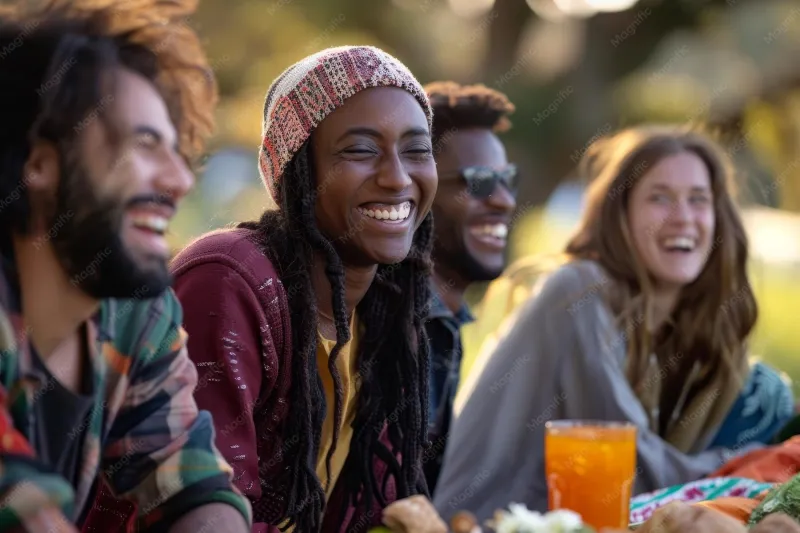
Photo: diverse group of friends laughing together at a casual gathering, via img.freepik.com
Kayla and Dani met in a Facebook group dedicated to a mid-budget fantasy series most people outside of a very specific corner of the internet have never heard of. Their first exchange was an argument — a genuinely heated disagreement about a character's season two arc that stretched across forty-seven comments and somehow ended with both of them laughing. That was six years ago. Last spring, Dani flew from Austin to Portland to be in Kayla's wedding.
This kind of story isn't rare. It's actually happening constantly, in communities built around everything from prestige dramas to obscure anime to niche podcast fandoms. And if you've experienced it yourself, you probably already know that trying to explain it to someone who hasn't can feel almost impossible.
"People look at me weird when I say my best friend is someone I met in a Discord server," Kayla told us. "Like I need to clarify that she's a real person. She's more real to me than half the people I grew up with."
Why Entertainment Communities Are Uniquely Built for Connection
Psychologists who study social bonding have a concept called shared reality — the idea that connection deepens dramatically when two people don't just experience the same thing, but interpret and feel it similarly. It's why talking about a movie you both loved can feel more intimate than a lot of surface-level real-world small talk.
Entertainment fandoms turbocharge this dynamic. When you find someone who cried at the same moment you did in a season finale, who noticed the same background detail in episode four, who has an equally unhinged theory about where the story is going — you're not just finding someone with similar taste. You're finding someone whose emotional and intellectual wiring resembles yours in a specific and meaningful way.
Dr. Pamela Rutledge, a media psychologist who has written extensively on parasocial relationships and fandom, has pointed out that entertainment gives communities a shared language — a set of references, emotions, and values that members can use to understand each other quickly. In a world where making new friends as an adult is notoriously difficult, that shortcut is genuinely powerful.
The Parasocial Foundation That Builds Real Bonds
Here's something that sounds counterintuitive at first: the parasocial relationship — that one-sided emotional connection fans feel toward a creator, character, or celebrity — often serves as the scaffolding for real, mutual friendships.
You bond with a creator's content alone in your room. You feel understood by it. Then you find a community of other people who felt the same way, and suddenly you're not alone anymore. The parasocial relationship didn't replace human connection — it pointed you toward it.
This is why entertainment communities often feel warmer and more immediately trusting than, say, a professional networking group or even a neighborhood association. Everyone showed up because they were moved by something. That shared vulnerability — the willingness to care loudly about a story — creates an unusually open emotional environment.
Marcos, a 31-year-old from Chicago, found his closest friend group through a community built around a long-running science fiction podcast. "We all had this thing in common that felt kind of embarrassing to admit to people in our regular lives," he said. "Like, I'm a grown man who gets genuinely emotional about fictional space exploration. Finding other people who were the same way — it was like being let out of a room I didn't know I was in."
When Online Becomes IRL: Navigating the Transition
Not every online friendship is meant to go further than the chat window, and that's completely fine. Some of the most meaningful connections people have exist entirely in text — and there's nothing lesser about that.
But for friendships that do move toward real-world territory, the transition can feel surprisingly awkward despite how well you already know each other. You've talked for hours. You've shared things you haven't told people you've known for years. And then you're standing at a coffee shop or a convention meetup and suddenly have to figure out what to do with your hands.
People who've made this leap successfully tend to offer similar advice: let the fandom be the bridge, not the whole relationship. Meet at an event or gathering where the shared interest is present, so you're not performing a friendship from scratch. And give each other room to be three-dimensional — the person you know from the fan thread is real, but they're also more than their hot takes about the season three villain.
Jennifer, who met her closest college-years friend through a Taylor Swift fan community and has since navigated a decade of friendship that long outlasted her active fandom, put it simply: "We stopped talking about Taylor pretty quickly. We just... became friends. The fandom was the door. We walked through it."
The Blurred Line That's Worth Examining
There's one complication worth naming honestly: online communities can sometimes create the feeling of deep friendship before the actual foundation is fully there. The intimacy of shared passion can accelerate emotional closeness in ways that occasionally outpace the real-world trust and reciprocity that sustain long-term relationships.
This isn't a reason to hold back — it's just a reason to stay a little self-aware. If you find yourself leaning on an online friendship for heavy emotional support very quickly, it's worth checking in with yourself about whether the relationship has had time to develop the mutual depth that kind of reliance requires.
Most of the time, it has. Fan communities have an unusual track record of producing friendships that are genuinely reciprocal, long-lasting, and surprisingly resilient. The data point that matters most isn't how you met — it's whether you show up for each other.
Your Tribe Is Closer Than You Think
At TribeAmest, we exist on the premise that your people are out there — and that shared passion for the things that move you is one of the most reliable maps for finding them. The science backs that up. The stories back that up.
Kayla and Dani started with a forty-seven-comment argument about a fictional character. Marcos found his people in a podcast forum. Jennifer walked through a fandom door and never looked back.
Your community is already gathering somewhere around something you love. The friendships that come out of it might end up being the ones that matter most.